
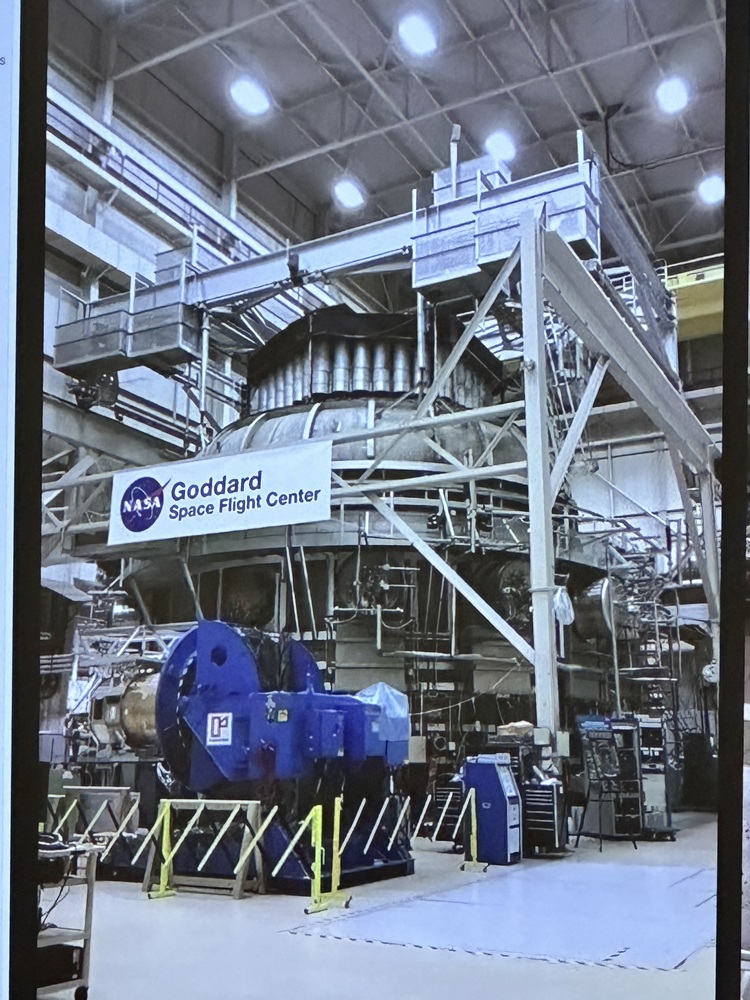
Students in Mrs. Brandie Roberts’ physical science classes traveled far beyond the classroom today, without ever leaving campus, during a virtual field trip hosted by NASA’s Goddard Space Flight Center.
Broadcast from Goddard’s main campus, the experience gave students an inside look at the facilities NASA operates across the United States and the critical role Goddard plays in supporting missions that study Earth, the Moon, the Sun, and deep space.
One highlight of the trip was learning about the James Webb Space Telescope, a mission that required more than 30 years of engineering and the work of over 2,000 people. Students discovered that the telescope is about the size of a tennis court and is capable of detecting water, signs of life, stars, and distant galaxies.
Students also explored Goddard’s testing facilities, where spacecraft are put through extreme conditions to ensure safety during launch and space travel. Engineers simulate intense vibration, sound, mechanical movement, and dramatic temperature changes ranging from below –400 degrees Fahrenheit to over 400 degrees Fahrenheit o test how spacecraft withstand the harsh realities of space.
The virtual tour highlighted several missions supported by Goddard, including Earth science research conducted from space. Using satellites, scientists can measure global precipitation, tree height, drought conditions, and more. Students learned that Earth can be scanned in just 90 minutes, with data transmitted back to Earth within one hour.
Another focus was the PACE mission, which studies the color of the ocean to analyze phytoplankton and better understand ocean health and Earth’s ecosystems. This research also helps scientists examine how the Sun interacts with clouds and the atmosphere, and how those interactions affect the oceans.
In planetary science, students learned about the Lunar Reconnaissance Orbiter, which has been orbiting the Moon in preparation for upcoming missions, including a planned 10-day astronaut mission later this spring. Goddard also supports missions studying how life might survive on other planets, such as Saturn, Mars, and Venus, with a new mission scheduled to launch later this year.
The trip concluded with a look at solar and astrophysics research. Goddard continues to use data from the Solar Dynamics Observatory, launched in 2010, to help predict and prepare for extreme space weather events that could impact communication and satellite systems on Earth. In astrophysics, scientists study exoplanets by observing stars and their orbits to identify potential planetary candidates beyond our solar system.
Through this immersive experience, students gained a deeper understanding of how classroom science connects to real-world research and discovery, proving that even a virtual trip can inspire big curiosity.